Breacher Up Fitness
Tactical / Military, Functional Training, Strength & Conditioning, General Fitness, Functional Fitness, Powerlifting, First Responders, Weightlifting, Power Sports , Law Enforcement6 sessions per week
Must use App app to view and log training
Team Training





Prep
A
Daily Devotional 7
Daily Bible Reading: Exodus 14:14 Leadership Lesson (Rest Day): Embrace the discipline of rest. Devotional: Today is another rest day, and after a week of receiving foundational laws and learning to delegate, the importance of discipline couldn't be clearer. Rest itself is an act of discipline. It is the discipline of saying no to the urgency of work and yes to the priority of restoration. The greatest leaders are not those who have mastered a particular field, but those who have mastered themselves. That self-mastery includes the ability to pause even when the job is unfinished. It’s tempting to use this day to catch up or get ahead, but if you cheat your rest today, you will have to cheat your work tomorrow. Use this day to practice self-mastery by doing something restorative—something that re-anchors your mind, body, and spirit. It’s not your job to manage the universe; you are called to manage the portion of the universe God has entrusted to you. And that management begins with taking care of yourself. Rest today so you can lead well tomorrow. Reflection Questions: Is your current rest truly restorative, or is it merely passive consumption (like scrolling or binge-watching)? How can you make your rest more active? What is the most important idea, principle, or insight from the past week that you need to meditate on today? Prayer: God, I thank You for the discipline of rest. I intentionally release the urge to work, hustle, and achieve today. I ask for Your presence to fill this time of stillness. Help me cultivate the self-mastery required to be a truly sustainable leader, leading from a heart and mind that are refreshed and renewed by You. Amen.
Prep
A
Daily Devotional 1
Daily Bible Reading: Exodus 23-26 Leadership Lesson: Build a sacred space for the mission. Devotional: In these chapters, God gives Moses detailed, architectural blueprints for the Tabernacle—the movable sanctuary where God’s presence would dwell. Every material, measurement, and curtain was specified precisely. God gave exact commands to build a sacred space for the mission. The lesson for leaders is that your mission needs a Tabernacle—a dedicated, intentional structure where your vision lives and your values are practiced. This isn't a physical office, but rather a structural and cultural container for the mission itself. Is your culture a haphazard collection of habits, or is it a carefully designed, intentional structure? If you want God’s presence and blessing on your mission, you have to create a place that honors it. This means being specific about your culture and designing systems where your values are clear. Just like the Tabernacle was built with precision, your leadership should be defined by intentional design. How does your meeting structure reflect your value of efficiency? How does your compensation system reflect your value of generosity? You can’t expect a sacred mission to thrive in a secular, haphazard structure. Great leaders don't just talk about culture; they build the Tabernacle by designing every detail of their organization to reinforce their core values. Start today by intentionally creating the space—the structures, the rules, and the boundaries—for your mission to thrive. Reflection Questions: What is one area of your organization (meeting structure, communication style, office layout) that feels haphazard and needs intentional design? If someone looked at your team's weekly schedule, what would they conclude are your non-negotiable values? Prayer: God, give me the visionary insight to not only have a mission but to intentionally design the structure that supports it. Help me see where my systems are hindering my values. Give me the commitment to detail necessary to build a sacred space—a culture—where Your presence and purpose can dwell. Amen.
B1
Crunch
15, 20, 25
B2
Feet Up DB Bench Press
15, 20, 25
B3
Cable Facepull
15, 20, 25
C1
Feet Up Close Grip Bench Press
4 x 8
C2
Ring Rows
4 x 8
D1
Banded DB Bench Press
4 x 10
D2
Pull-Up
4 x 8
E1
Hammer Curl Gun Walk
4 x 30
E2
DB Roll Back
4 x 12
Operational Capacity Circuit
F
In remaining time on 60-minute workout clock perform as many rounds as possible of: 10 Barbell Back Squats 135# 10 Burpees 10 Box Jumps 24/20" Each round completed = 1000 points towards your final score. Each partial rep = 10 points Example: 2 fully completed rounds + 10 back squats + 3 burpees = 2,130 points
Conditioning
G
Final Score
Final Score: Add total weight lifted this session (shown on the top of the app) + points accrued during the operational circuit
1/2 Marathon Prep
A
Easy Run 5 min slow jog 1 Mile Run 5 min slow jog
General Fitness
B
5 minute warm up jog -then 8 rounds- 600 m run 75 sec walk -then- 10 minute cool down walk
Prep
A
Daily Devotional 1
Daily Bible Reading: Exodus 27-30 Leadership Lesson: Leaders are clothed in excellence. Devotional: Exodus 28 describes the intricate robes designed for the priests, especially Aaron. The clothes were beautiful and made of fine linen, gold, and precious stones, complete with an ephod and a breastpiece. The instructions were meticulous because the garments represented the dignity of the office. The priests were to be "clothed in excellence" when they stood before God. This is a powerful illustration for organizational excellence. As a leader, you don’t wear a breastpiece of twelve stones, but you are clothed in the standard of excellence you set for your team. Every task—from the highest-level presentation to the simplest email—reflects the dignity you give to the mission. This doesn't mean you need to be flashy or expensive. Instead, it means being intentional and meticulous. It means refusing to do a job half-heartedly just because it's behind the scenes. It means putting thought into the clarity of your communication, the quality of your product, and the care in your service. If you accept sloppiness in small things, you breed mediocrity in everything. The leader who accepts an average presentation will eventually get an average product. Your leadership attire is your commitment to quality. When your team sees you demand excellence in the small details, they learn that the work is sacred. Let your presence as a leader and the output of your team be clear statements that the mission you serve is worthy of the best you have to offer. Reflection Questions: In what area of your work have you been letting the standard slip because you felt the task was "minor" or "behind the scenes"? What is one practical detail of your work that you can elevate today to embody a greater commitment to excellence? Prayer: God, I pray for a renewed commitment to excellence. Forgive me for settling for "good enough" when You call me to my best. Help me to lead with meticulous care, ensuring that every output of my team reflects the dignity of the mission You have given us. May my standards be high for the glory of Your Name. Amen.
B1
Banded Russian KB Swing
3 x 10
B2
Yox Shrug
3 x 12
C
Seated Box Jump
5 x 3
D
Sumo Deadlift
3 x 3
E
Pendlay Row
3 x 8
F
Single Arm Banded KB Farmer Carry
2 x 60
G1
Back Extension
1 x 60
G2
DB Shrug
1 x 60
Operational Capacity Circuit
H
In remaining time on 60-minute workout clock perform as many rounds as possible of: While wearing kit or 20# weight vest 400m Run 40 Air Squats 20 Push Ups Each round completed = 1000 points towards your final score if wearing a kit/vest, 500 points if no vest. Each partial 100m = 10 points Each additional air squat and push up completed =1 point Example: 2 fully completed rounds + 200m with vest = 2,020 points
Conditioning
I
Final Score
Final Score: Add total weight lifted this session (shown on the top of the app) + points accrued during the operational circuit
1/2 Marathon Prep
A
30 Minute cardio machine of choice
General Fitness
B
45 minute easy jog
Prep
A
Daily Devotional 4
Daily Bible Reading: Exodus 31-34 Leadership Lesson: Intercession is the highest form of advocacy. Devotional: In Exodus 32, while Moses was on the mountain receiving the Law, the people below melted their gold and created a golden idol to worship. They abandoned their commitment to God barely forty days after they made it. In His righteous anger, God told Moses He would destroy the people and start over with him. In that explosive moment, Moses stepped into his highest leadership calling: intercession. He argued for the people, reminding God of His own promises to Abraham. Moses stood in the gap between the people and God's judgment to save the very people who had just betrayed him. His leadership wasn't defined by his public image but by his private prayer. Intercession is the highest form of advocacy. As a leader, you are responsible for the people under your care—and that responsibility extends to their failings. When your team makes a mistake, your first response shouldn't be to blame or disown them, but to stand in the gap and fight for their future. When your team fails, do you expose them or advocate for them? Do you use their failure to protect your own image, or do you use your authority to protect their future? The greatest leaders spend more time advocating for their people behind closed doors than they do criticizing them in public. Fight for your team—even when they make it hard. Reflection Questions: Who on your team has made a mistake recently that you have been tempted to expose or harshly criticize? How can you advocate for them instead? What time or routine can you establish for interceding in private for the people and mission you lead? Prayer: God, give me a heart for the people I lead, even when they are weak or make mistakes. When they fall, help me to stand in the gap, not to join the judgment. Strengthen my ability to advocate for their future by reminding me of Your promises to them. May my leadership be marked by courageous intercession. Amen.
Circuit
B
For Time 200 Calorie Air Bike Every 1:00 including minute 0:00 complete 6 burpees
C
Cardio
1 x 30:00
Prep
A
Daily Devotional 1
Daily Bible Reading: Exodus 35-38 Leadership Lesson: Honor the craftspeople. Devotional: After the disaster of the golden calf, the focus returned to the Tabernacle. In Exodus 35, Moses was looking for the necessary talent to build the elaborate structures. He named two men—Bezalel and Oholiab—and described their unique, God-given skills: the ability to work with gold, silver, wood, and stone, and the ability to teach others. The lesson here is urgent but often overlooked: Honor the craftspeople. The glory of God's presence didn't rest on the idea of the Tabernacle but on the execution of the craftsmen. Moses, the visionary and deliverer, needed the skills of those who could actually build the detailed, intricate work. As a leader, you may be a Moses—the visionary who sets the direction—but you have to constantly celebrate and empower the Bezalels and Oholiabs on your team. These are the people who can take a messy vision and turn it into reality. They are the detail-oriented ones, the skilled executors, the people who bring excellence to everything they do. A common mistake is for leaders to only celebrate the visionary, charismatic, or public-facing roles. But the true strength of an organization is often found in the focused excellence of the craftspeople. Do you know the unique, God-given skills of the people on your team? Do you consistently honor their specific craft? If you only celebrate the strategic talkers, you will eventually lose the skilled doers. Empower your craftspeople, give them the necessary resources, and let their meticulous work be the pride of your organization. Reflection Questions: Who are the craftspeople on your team (the detail-oriented doers) that you have failed to publicly acknowledge or honor recently? How can you structure your praise this week to specifically celebrate execution and quality instead of just ideas or initiative? Prayer: God, I ask for the humility to recognize and honor the talents of those I lead. Help me to be a leader who empowers the executors, the builders, and the detail-oriented people who turn vision into reality. Bless their meticulous work, and remind me that the success of the mission depends on every specialized gift. Amen.
B1
Incline Hex Press
12, 16, 20
B2
Crunch
12, 16, 20
B3
Band No Money's
3 x 8
C1
Z-Press
3 x 8
C2
Lat Pull Downs
3 x 6
D
DB Floor Press
3 x 12
E1
Incline DB Y Raise
3 x 10
E2
DB Lateral Raise
3 x 12
E3
Chest Supported Band Pull Apart
3 x 14
F1
Plank
3 x 0:30
F2
Butterfly Sit Ups
3 x 12
Operational Capacity Circuit
G
In remaining time on 60-minute workout clock perform as many rounds as possible of: 200m Run 200 Cable Tricep Press Downs 30# Each round completed = 1000 points towards your final score. Additional runs = 10 points per 50 meters Additional press downs = 1 per rep Example: 2 fully completed rounds + 200 m run + 40 press downs = 2,240 points
Conditioning
H
Final Score
Final Score: Add total weight lifted this session (shown on the top of the app) + points accrued during the operational circuit
1/2 Marathon Prep Option
A
Easy Run 5 minute warm-up jog -then- 0.8 mile run at conversational pace 90 second walk 0.2 mile run at a 10:00 pace or faster 30 second walk 0.8 mile run at conversational pace -then- 5 minute cool down jog
General Fitness Option
B
14 Rounds for Time 150m run 45 sec rest
Prep
A
Daily Devotional 1
Daily Bible Reading: Exodus 39-40, Leviticus 1-2 Leadership Lesson: Inspection ensures ownership. Devotional: Exodus 39 and 40 are essentially a final inspection report. After all the skilled laborers completed their work on the Tabernacle and the priestly garments, Moses carefully inspected everything. Chapter 39 ends with the phrase, "So the Israelites did everything just as the Lord commanded Moses" (verse 32 NIV). And chapter 40 concludes with Moses setting up the Tabernacle and the cloud of God's presence descending. The final inspection is the critical step that shows ownership and expects excellence. This step doesn't make you a micromanager; it models a commitment to the vision and mission of the team. The lesson for us: Inspection ensures ownership. If you delegate a project and never follow up, you are essentially telling your team that the final quality doesn't matter much. When you inspect the work, you demonstrate that you care about the details, which in turn reinforces your team's commitment to quality. Furthermore, when Moses completed the inspection and the setup, it was he, the leader, who initiated the final action. He took full ownership of the finished product. Do you have a consistent process for inspecting the work your team delivers? If not, you’re creating an environment where good effort will potentially lead to poor results. When you inspect, you are not questioning their talent; you are confirming their commitment to the shared standard of excellence. Inspect the work, honor the effort, and watch your team’s sense of ownership grow. Reflection Questions: What key project or deliverable have you recently delegated that you need to schedule a formal, thorough inspection for? What is your current balance between trusting your team and verifying the results? Do you need to adjust? Prayer: God, help me to be a leader of integrity and accountability. Give me the diligence of Moses to inspect the finished work and ensure that every detail meets the standard of excellence. Teach me to lead with a balance of trust and verification, so that my team takes full ownership of the mission. Amen.
B1
Leg Extension
3 x 10
B2
DB Side Bend
3 x 15
B3
Crunch
3 x 15
C
1 1/4 Back Squat
5 x 5
D
Zercher Good Morning
4 x 6
E
Goblet Squat
3 x 30
F
Seated Leg Curls
1 x 60
Operational Capacity Circuit
G
In remaining time on 60-minute workout clock perform as many rounds as possible of: 8 Devil Press 50/35# 16 DB Box Step Overs 50/35# 24 Single DB Hang Clean and Jerk 50/35# Each round completed = 1000 points towards your final score. Each partial rep = 1 points Example: 2 fully completed rounds + 8 Devil Press + 16 Step Overs + 4 Clean and Jerks = 2,028 points
Conditioning
H
Final Score
Final Score: Add total weight lifted this session (shown on the top of the app) + points accrued during the operational circuit
1/2 Marathon Prep
A
30 minute cardio machine of choice
General Fitness Run
B
50 minute jog
Prep
A
Daily Devotional 1
Daily Bible Reading: Leviticus 3-6 Leadership Lesson: The cost of sin is non-negotiable. Devotional: As the Israelites moved from setting up the Tabernacle to understanding their daily lives, the book of Leviticus clarifies the rules for sacrifice and atonement. These chapters deal with sin, guilt, and the specific cost required to restore the broken relationship with God. The lesson is simple, yet essential to remember: The cost of sin is non-negotiable. In leadership, it can be tempting to wave away mistakes, hoping they will disappear. We might allow a toxic comment to slide, cover up a small financial oversight, or overlook a breach of integrity in the name of efficiency. But unaddressed sin or failure leaves a moral debt on the organization. The laws of sacrifice show that there is always a cost for reconciliation. The blood had to be poured out. The animal had to be given. Something had to pay the price for the sin to be truly atoned for and the relationship to be restored. This translates into leadership accountability: When a team member makes a mistake, the cost must be accounted for. That cost may be a public apology, a financial repayment, retraining, or even separation from the organization. The alternative is what we see in many organizations: a culture of denial where mistakes are swept under the rug and integrity slowly erodes. Great leaders understand that a system that allows mistakes to go unaddressed is a system that is rotting from the inside. Be the leader who makes sure the cost of sin is paid, restoring integrity and upholding the values and reputation of the organization. Reflection Questions: In what areas have you allowed a mistake or breach of integrity to go unaddressed? What is the unseen cost of that inaction? What is the standard cost—the "sacrifice"—you have established for accountability in your organization? Is it clear to everyone? Prayer: God, give me the courage to lead with uncompromised integrity. Help me understand that every failure has a cost that must be accounted for. Strengthen me to enact necessary discipline and accountability, not out of anger, but out of a deep commitment to the moral health of my organization. Amen.
B1
DB Bicep Curls
3 x 12
B2
Feet Up DB Bench Press
15, 20, 25
B3
Cable French Press
3 x 12
C
Hammer Curl
4 x 8
D
DB Roll Back
4 x 12
E
Preacher Curl
4 x 12
F
Tricep Pushdown
4 x 12
G
Barbell Flexion Wrist Curl
3 x 30
Operational Capacity Circuit
H
In remaining time on 60-minute workout clock perform as many rounds as possible of: 200m Farmer Carry 35/20# 10 Burpees 20 Box Jumps 24/20" 30 Alternating DB Snatch 35/20# Each round completed = 1000 points towards your final score. Each 50m farmer carry = 10 points Each partial box jump/snatch = 1 point per rep Example: 0 fully completed rounds + 200m Farmer Carry + 10 burpees + 20 box jumps + 10 Snatches = 80 points
Conditioning
I
Final Score
Final Score: Add total weight lifted this session (shown on the top of the app) + points accrued during the operational circuit
1/2 Marathon Prep
A
Easy Run 5 minute warm-up walk -then 3 rounds- 0.8 mile run at a conversational pace 90 sec walk 5 minute cool down walk
General Fitness
B
20 min run at a conversational pace -then 4 rounds- 8 min zone 2 jog 2 min zone 3 run -then- 20 min cooldown walk
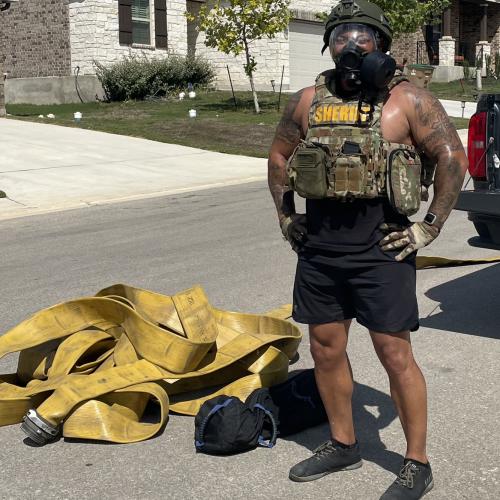
When you join a team you’re getting more than programming, you’re joining an online community.
Breacher Up Functional Fitness
 Breacher Up Functional Fitness
 Breacher Up Functional Fitness