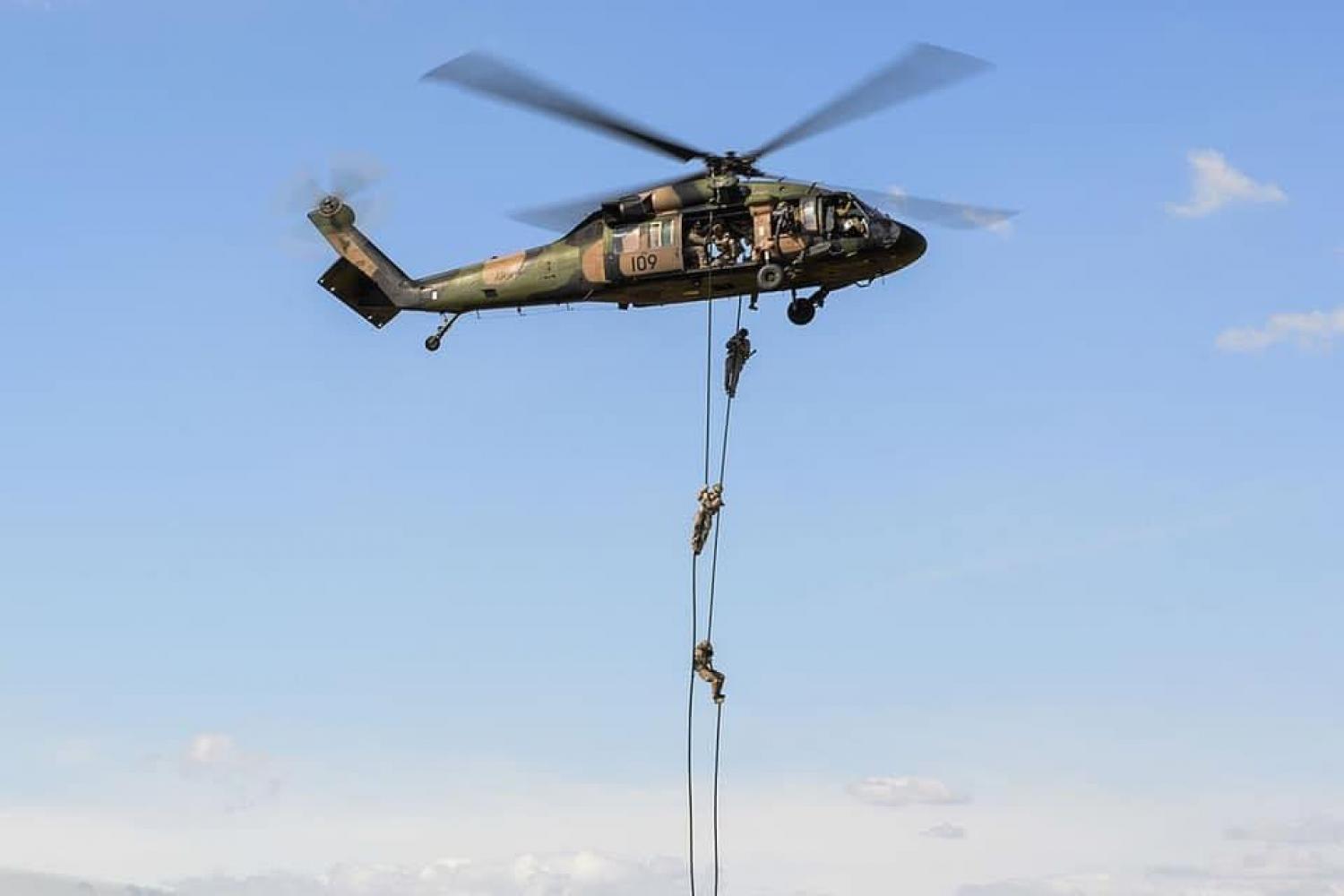
Enhanced Tactical Performance
General FitnessStay consistent. Stay fit. Enjoy the holidays.
The Christmas holiday period often brings disrupted routines, travel, social commitments, and limited training opportunities.
This 4-week program is designed to help you maintain your hard-earned fitness without sacrificing your holiday time.
Taking a well-rounded approach to physical fitness, the program incorporates strength, power, muscular endurance, cardiovascular conditioning, mobility, and functional movement to ensure all aspects of fitness are addressed.
With main training components lasting no more than 30 minutes, each session is designed to maximise training efficiency while fitting around your holiday commitments.
The goal is simple: Stay active, maintain your physical capabilities, and return from the holidays ready to hit the ground running.
1 sessions per week
Must use App app to view and log training
Program Training


Conditioning
A
Basic RAMP Warm Up Guide
Follow the below sequence. Choose your own exercises to meet the intent of preparing you physically and mentally for the exercise to come. Raise - Spend 3-5min carrying out basic exercises looking to raise your core temperature, increase blood flow to peripheral muscles, and increase synovial fluid production within the joints. Activation - Spend 3-5min performing low level isolation or isometric exercises which can aide in the activation and excitement of muscles directly involved in stabilising joints in the activities that follow, or that have presented you with issues in the past. Mobilisation - Spend 3-5min performing exercises that dynamically place all muscles and joints through their full range of motion. Potentiation - Spend 3-5min performing exercises that directly replicate the actions or exercises in the main body of the session, gradually increase the intensity or volume to a level that is proportionate to that of which you are about to conduct.
Conditioning
B
Assault Bike - 15 x 1min Work / 1min Rest
Complete 15 rounds of: - 1min Assault Bike @ 90-100% MAP (Swap for running or another machine if you do not have access to an assault bike) - 1min Passive Rest Record the total number of calories you accumulate across all rounds as your score. In the comment, record: - What was completed. - Average Power/RPM - Ave HR - Max HR - RPE - AAR points
Conditioning
C
Basic Cool Down Guide
The basic premise of the cool down is to down regulate your body from what could be assumed was a period of activity that was dominated by the activation of the sympathetic nervous system. By following these steps you will enable you to return to a state where the appropriate resources can be applied by the body to kick start the recovery process. To do this appropriately will be very dependent on a number of individual factors that are both physiological and psychological in nature. Following the next three stages, can act as a guide for you but do not be afraid of trying new things or continuing to do what you feel works best for you. Stage 1 - Spend some time reducing the heart rate gradually towards zone 2 or 1, this can be achieved simple by continuing low intensity exercise, walking around or even packing away your equipment. Stage 2 - Controlled breathing, spending 3-5minutes focusing on long and controlled breathing. Starting initially with what is comfortable for you, as time progresses attempt to slow it to a point where you are completing close to 5 breaths (inhale and exhale) per minute. Stage 3 - Performing stretches is the most common choice but is by no means always necessary. Throughout the controlled breaths perform a scan of your body and identify any areas you feel maybe overly "tight" and address them with any mechanism you wish, this could be through any form or compression / vibration therapy / foam rolling / self myofascia release / or stretching.
Conditioning
A
Basic RAMP Warm Up Guide
Follow the below sequence. Choose your own exercises to meet the intent of preparing you physically and mentally for the exercise to come. Raise - Spend 3-5min carrying out basic exercises looking to raise your core temperature, increase blood flow to peripheral muscles, and increase synovial fluid production within the joints. Activation - Spend 3-5min performing low level isolation or isometric exercises which can aide in the activation and excitement of muscles directly involved in stabilising joints in the activities that follow, or that have presented you with issues in the past. Mobilisation - Spend 3-5min performing exercises that dynamically place all muscles and joints through their full range of motion. Potentiation - Spend 3-5min performing exercises that directly replicate the actions or exercises in the main body of the session, gradually increase the intensity or volume to a level that is proportionate to that of which you are about to conduct.
B
DB Bench Press
C
1-Arm DB Row
D
Goblet Squat
E
Barbell Bicep Curl
Conditioning
F
Basic Cool Down Guide
The basic premise of the cool down is to down regulate your body from what could be assumed was a period of activity that was dominated by the activation of the sympathetic nervous system. By following these steps you will enable you to return to a state where the appropriate resources can be applied by the body to kick start the recovery process. To do this appropriately will be very dependent on a number of individual factors that are both physiological and psychological in nature. Following the next three stages, can act as a guide for you but do not be afraid of trying new things or continuing to do what you feel works best for you. Stage 1 - Spend some time reducing the heart rate gradually towards zone 2 or 1, this can be achieved simple by continuing low intensity exercise, walking around or even packing away your equipment. Stage 2 - Controlled breathing, spending 3-5minutes focusing on long and controlled breathing. Starting initially with what is comfortable for you, as time progresses attempt to slow it to a point where you are completing close to 5 breaths (inhale and exhale) per minute. Stage 3 - Performing stretches is the most common choice but is by no means always necessary. Throughout the controlled breaths perform a scan of your body and identify any areas you feel maybe overly "tight" and address them with any mechanism you wish, this could be through any form or compression / vibration therapy / foam rolling / self myofascia release / or stretching.
Conditioning
A
Basic RAMP Warm Up Guide
Follow the below sequence. Choose your own exercises to meet the intent of preparing you physically and mentally for the exercise to come. Raise - Spend 3-5min carrying out basic exercises looking to raise your core temperature, increase blood flow to peripheral muscles, and increase synovial fluid production within the joints. Activation - Spend 3-5min performing low level isolation or isometric exercises which can aide in the activation and excitement of muscles directly involved in stabilising joints in the activities that follow, or that have presented you with issues in the past. Mobilisation - Spend 3-5min performing exercises that dynamically place all muscles and joints through their full range of motion. Potentiation - Spend 3-5min performing exercises that directly replicate the actions or exercises in the main body of the session, gradually increase the intensity or volume to a level that is proportionate to that of which you are about to conduct.
Conditioning
B
Ski Erg - 6 x 4min Work / 1min Rest
For max calories, complete: 6 rounds of: - 4min Ski Erg (Run or use an alternative machine if a ski erg is not available) - 1min Rest Record the total number of calories you achieve. In the comment, record: - Cals achieved in each round - RPE - Ave HR - Max HR - AAR points
Conditioning
C
Basic Cool Down Guide
The basic premise of the cool down is to down regulate your body from what could be assumed was a period of activity that was dominated by the activation of the sympathetic nervous system. By following these steps you will enable you to return to a state where the appropriate resources can be applied by the body to kick start the recovery process. To do this appropriately will be very dependent on a number of individual factors that are both physiological and psychological in nature. Following the next three stages, can act as a guide for you but do not be afraid of trying new things or continuing to do what you feel works best for you. Stage 1 - Spend some time reducing the heart rate gradually towards zone 2 or 1, this can be achieved simple by continuing low intensity exercise, walking around or even packing away your equipment. Stage 2 - Controlled breathing, spending 3-5minutes focusing on long and controlled breathing. Starting initially with what is comfortable for you, as time progresses attempt to slow it to a point where you are completing close to 5 breaths (inhale and exhale) per minute. Stage 3 - Performing stretches is the most common choice but is by no means always necessary. Throughout the controlled breaths perform a scan of your body and identify any areas you feel maybe overly "tight" and address them with any mechanism you wish, this could be through any form or compression / vibration therapy / foam rolling / self myofascia release / or stretching.
Conditioning
A
Basic RAMP Warm Up Guide
Follow the below sequence. Choose your own exercises to meet the intent of preparing you physically and mentally for the exercise to come. Raise - Spend 3-5min carrying out basic exercises looking to raise your core temperature, increase blood flow to peripheral muscles, and increase synovial fluid production within the joints. Activation - Spend 3-5min performing low level isolation or isometric exercises which can aide in the activation and excitement of muscles directly involved in stabilising joints in the activities that follow, or that have presented you with issues in the past. Mobilisation - Spend 3-5min performing exercises that dynamically place all muscles and joints through their full range of motion. Potentiation - Spend 3-5min performing exercises that directly replicate the actions or exercises in the main body of the session, gradually increase the intensity or volume to a level that is proportionate to that of which you are about to conduct.
B
DB Romanian Deadlift
4 x 8
C
Seated Arnold DB Press
3 x 12
D
Lateral Raise With External Rotation
2 x 20
E
Reverse Hyperextension
2 x 20
F
Seated Calf Raise
2 x 20
G
Cable Ab Crunches
2 x 20
Conditioning
A
Basic RAMP Warm Up Guide
Follow the below sequence. Choose your own exercises to meet the intent of preparing you physically and mentally for the exercise to come. Raise - Spend 3-5min carrying out basic exercises looking to raise your core temperature, increase blood flow to peripheral muscles, and increase synovial fluid production within the joints. Activation - Spend 3-5min performing low level isolation or isometric exercises which can aide in the activation and excitement of muscles directly involved in stabilising joints in the activities that follow, or that have presented you with issues in the past. Mobilisation - Spend 3-5min performing exercises that dynamically place all muscles and joints through their full range of motion. Potentiation - Spend 3-5min performing exercises that directly replicate the actions or exercises in the main body of the session, gradually increase the intensity or volume to a level that is proportionate to that of which you are about to conduct.
Conditioning
B
Mixed Modality - 30min AMRAP of: 800m Run / 8 Burpees / 16 Lunges / 24 Push Ups / 32 Air Squats
30min AMRAP of: - 800m Run - 8 Burpees - 16 Lunges (reverse lunges, 8 per side) - 24 Push Ups - 32 Air Squats Record the number of rounds you complete as your score. In the comment, record: - What you complete. - Ave HR - Max HR - RPE - AAR
Conditioning
C
Basic Cool Down Guide
The basic premise of the cool down is to down regulate your body from what could be assumed was a period of activity that was dominated by the activation of the sympathetic nervous system. By following these steps you will enable you to return to a state where the appropriate resources can be applied by the body to kick start the recovery process. To do this appropriately will be very dependent on a number of individual factors that are both physiological and psychological in nature. Following the next three stages, can act as a guide for you but do not be afraid of trying new things or continuing to do what you feel works best for you. Stage 1 - Spend some time reducing the heart rate gradually towards zone 2 or 1, this can be achieved simple by continuing low intensity exercise, walking around or even packing away your equipment. Stage 2 - Controlled breathing, spending 3-5minutes focusing on long and controlled breathing. Starting initially with what is comfortable for you, as time progresses attempt to slow it to a point where you are completing close to 5 breaths (inhale and exhale) per minute. Stage 3 - Performing stretches is the most common choice but is by no means always necessary. Throughout the controlled breaths perform a scan of your body and identify any areas you feel maybe overly "tight" and address them with any mechanism you wish, this could be through any form or compression / vibration therapy / foam rolling / self myofascia release / or stretching.
Conditioning
A
Basic RAMP Warm Up Guide
Follow the below sequence. Choose your own exercises to meet the intent of preparing you physically and mentally for the exercise to come. Raise - Spend 3-5min carrying out basic exercises looking to raise your core temperature, increase blood flow to peripheral muscles, and increase synovial fluid production within the joints. Activation - Spend 3-5min performing low level isolation or isometric exercises which can aide in the activation and excitement of muscles directly involved in stabilising joints in the activities that follow, or that have presented you with issues in the past. Mobilisation - Spend 3-5min performing exercises that dynamically place all muscles and joints through their full range of motion. Potentiation - Spend 3-5min performing exercises that directly replicate the actions or exercises in the main body of the session, gradually increase the intensity or volume to a level that is proportionate to that of which you are about to conduct.
Conditioning
B
Swimming Circuit - Ladder Climb Workout
Choose the variation that best suites you: 50 / 100 / 150 / 200 / & 250m Swim (Any stroke) *After each set complete: Level 1 - 10 burpees Level 2 - 15 burpees Level 3 - 20 burpees Record the time you achieve. In the comment, record: - The level you of work you complete - Round split times - Any other modification you had to make.
Conditioning
C
Basic Cool Down Guide
The basic premise of the cool down is to down regulate your body from what could be assumed was a period of activity that was dominated by the activation of the sympathetic nervous system. By following these steps you will enable you to return to a state where the appropriate resources can be applied by the body to kick start the recovery process. To do this appropriately will be very dependent on a number of individual factors that are both physiological and psychological in nature. Following the next three stages, can act as a guide for you but do not be afraid of trying new things or continuing to do what you feel works best for you. Stage 1 - Spend some time reducing the heart rate gradually towards zone 2 or 1, this can be achieved simple by continuing low intensity exercise, walking around or even packing away your equipment. Stage 2 - Controlled breathing, spending 3-5minutes focusing on long and controlled breathing. Starting initially with what is comfortable for you, as time progresses attempt to slow it to a point where you are completing close to 5 breaths (inhale and exhale) per minute. Stage 3 - Performing stretches is the most common choice but is by no means always necessary. Throughout the controlled breaths perform a scan of your body and identify any areas you feel maybe overly "tight" and address them with any mechanism you wish, this could be through any form or compression / vibration therapy / foam rolling / self myofascia release / or stretching.